
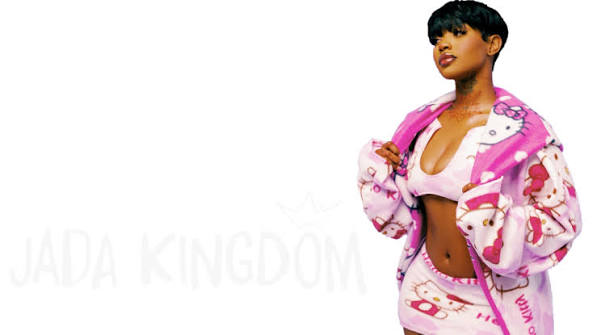
Jada Kingdom: The Unfiltered Voice of Dancehall
Jada Kingdom has never seemed interested in entering dancehall quietly. From the moment she began attracting attention, there was something unmistakably bold about her. She had the look, the confidence and the social-media presence, but beneath all of that was a voice that did not sound like anyone else’s. It was soft without being weak, emotional without losing its edge, and sensual without feeling manufactured.
In an industry where artistes are often pressured to fit neatly into one category, Jada Kingdom has made a career out of refusing to be boxed in.
Born Jada Ashanti Murphy and raised in 7 Mile, Bull Bay, she came from circumstances far removed from the glamour now associated with her name. She has spoken about growing up in a small home with her mother and siblings, watching her mother struggle and sacrifice to support the family. Long before major collaborations and international stages, her life was shaped by poverty, complicated family relationships and the determination to create something bigger for herself.
Her first introduction to the public was not through music. She gained attention as a swimsuit model and social-media personality and appeared in the video for Sean Kingston’s “One Away.” That visibility could easily have trapped her in the role of “Instagram model,” especially in a culture that is quick to judge women by their appearance. Instead, she used the attention as a doorway. In 2017, she began releasing music, including the R&B-influenced “Love Situations,” and steadily proved that she had far more to offer than photographs and popularity.
That transition matters because Jada’s career has always carried an unspoken challenge: the need to convince people that beauty and talent can exist in the same woman.
Female artistes are often treated as though one must cancel out the other. When a woman is attractive, some people assume her success is based on her appearance. When she is openly sensual, her writing and musical ability may be ignored. Jada Kingdom has spent years pushing against that narrow way of thinking.
Her music helped her do it.
Songs such as “Banana,” “Heavy,” “WiN,” “Jungle,” “GPP,” “Last Night” and the explosive “WHICH GYAL” freestyle revealed different sides of the same artiste. She could sing about desire with a smoky calm, switch into a sharper dancehall flow or deliver lyrics filled with pain and frustration.
“WiN” carried an uplifting message and became one of Jamaica’s major trending songs in 2020. It showed a more personal side of Jada, with visuals filmed in Bull Bay and featuring members of her family. “GPP,” on the other hand, was playful, provocative and almost impossible to ignore. She was not repeating one successful formula; she was building a catalogue around emotion, personality and lived experience.
That versatility remains one of her strongest weapons.
Jada’s sound sits somewhere between dancehall, R&B, pop, trap and, at times, soul and jazz. She has embraced that mixture rather than allowing the industry to decide what she should be. Her influences range from Nina Simone and Amy Winehouse to Diana King, Spice and Vybz Kartel. The result is music that remains Jamaican in language and attitude while still feeling capable of travelling far beyond the island.
Her voice is another important part of the appeal. Jada does not always overpower a rhythm. Sometimes she floats across it, allowing her melodies and tone to carry the emotion. Then, without warning, she can switch into a sharper delivery and remind listeners that she is fully capable of defending herself lyrically.
That contrast keeps her music interesting. One moment she sounds wounded; the next she sounds dangerous.
Jada’s collaborations have also demonstrated her range.
She has worked with artistes including John Legend, Popcaan, Skillibeng, Mr Eazi and Megan Thee Stallion. Her appearance with John Legend on “Speak in Tongues” was especially revealing because it placed her voice in a polished R&B setting without removing its Jamaican character. She did not need to flatten her accent or pretend to be someone else to fit the record.
That ability to move between musical worlds could eventually become one of the most important parts of her career.
Jamaican artistes often face pressure to change themselves when pursuing international success. Their accents may be softened, their lyrics simplified and their sound altered to become more acceptable to foreign audiences. Jada’s challenge is to expand globally without losing the rawness that made people notice her in the first place.
So far, she has shown that she understands the importance of remaining herself.
Jada Kingdom’s journey has not been smooth.
In 2021, she signed with Republic Records in a deal that attracted significant attention. The signing appeared to place her alongside some of the world’s biggest recording stars and gave the impression that her international breakthrough was only a matter of time.
However, by 2023, Jada had left the label and described herself as fully independent. She explained that the situation no longer felt right and that she wanted to preserve her identity and creative control. Leaving a major label meant losing access to a powerful promotional machine, but it also placed her career more firmly in her own hands.
Her attitude during that period could be summed up in one simple statement: “I always want to be me.”
That independence has become a central part of her current story.
In 2025, she spoke proudly about the support for songs such as “G.A.D,” “Can’t Tell Me That” and “Only You,” especially because she was working without a major marketing team behind her. Her success was no longer being presented as the result of a large label campaign. It was increasingly connected to her fan base, her creative instincts and her ability to generate attention through the music itself.
Then came a particularly productive 2026.
She released the six-track project Just a Girl in a Money Man’s World, followed by the four-track New Religion EP. The first project reached the top of several Caribbean Apple Music charts, while “G.A.D” later earned a Caribbean Music Award nomination for Song of the Year. In July 2026, she continued the momentum with “Move,” a sultry collaboration with dancehall veteran Cham.
The title Just a Girl in a Money Man’s World says a great deal about the position Jada occupies.
Dancehall is filled with talented women, but the machinery surrounding the music—management, production, financing and promotion—has traditionally been controlled largely by men. A female artiste must often fight not only to be heard, but also to control how she is presented.
Jada’s career reflects that struggle. She is outspoken, sometimes controversial and seemingly unwilling to become easier for the industry to manage. Perhaps that is precisely the point.
Of course, no discussion of Jada Kingdom’s public career would feel complete without addressing her well-known feud with Shenseea.
Both women emerged as major new female voices during roughly the same period, making comparisons almost unavoidable. They were young, confident, attractive, commercially promising and building passionate fan bases. Unfortunately, what began as tension soon developed into one of the most talked-about rivalries in modern dancehall.
Reports trace the public disagreement to 2018, after a hairdresser—identified in coverage as Jada’s cousin—left a comment about Shenseea’s hairstyle. Shenseea responded, Jada became involved, and the exchange grew beyond the original issue. According to reports from that period, Shenseea believed Jada was seeking public attention despite the two having already discussed the matter privately.
Social media then did what social media often does: it transformed a personal disagreement into public entertainment.
Fans chose sides. Screenshots circulated. Every post, lyric and comment was examined for hidden insults. It was no longer only about the two women involved. Their supporters became part of the confrontation, constantly demanding responses and treating silence as weakness.
The tension reached another level at the Red Bull Culture Clash in Kingston in November 2019.
During the event, Shenseea delivered a direct and insulting freestyle aimed at Jada, who was also present. Jada appeared to be caught off guard, but she did not remain silent for long. The following day, she answered with “Shen Heng,” a full diss track targeting Shenseea’s image, reputation and credibility.
The song quickly became part of dancehall clash conversation, with many listeners praising Jada for responding through music instead of relying only on Instagram arguments. It also demonstrated a side of her that casual listeners may not have expected. The soft voice was still there, but so were aggression, strategy and sharp lyrical attacks.
Their rivalry resurfaced in March 2020 following the release of Shenseea’s “The Sidechick Song,” leading to further online jabs and intense fan debate. By then, the feud had grown larger than either woman. It had become a dancehall spectacle.
The conflict also exposed an uncomfortable habit within the music industry.
Whenever two female artistes become successful, audiences often behave as though only one of them can survive. Instead of allowing each woman to have her own style, sound and audience, the public demands a competition. Who is prettier? Who has the better body? Who is more talented? Who has the bigger career? Who is the true queen?
Male artistes are allowed to dominate at the same time. Female artistes are frequently placed in a room with one chair.
The Jada and Shenseea feud benefited from that mentality. Their disagreements may have been real, but the public’s appetite for conflict kept adding fuel. Even when neither woman released a direct response, supporters continued the battle on their behalf.
Thankfully, the story did not end with another diss song.
Following the death of Shenseea’s mother in June 2020, Jada publicly offered condolences. She acknowledged the seriousness of Shenseea’s loss and later declared that she no longer wanted to continue feuding with other entertainers.
By August, the two women were following each other again on Instagram. Shenseea publicly supported Jada after several of her songs began trending, and Jada joked that she could finally stop hiding when singing along to Shenseea’s music in public. Based on the public record, their feud belongs to the past rather than the present.
That resolution may ultimately be more meaningful than the conflict itself.
Clashes have always been part of dancehall culture. Competition can sharpen artistes, create excitement and produce unforgettable lyrics. However, there is a difference between musical rivalry and personal hostility that encourages fans to degrade women.
Jada and Shenseea choosing peace showed maturity. It also prevented an already intense rivalry from becoming even more damaging.
Most importantly, it allowed Jada’s music to return to the centre of her story, where it belongs.
The Shenseea feud may have generated headlines, but it is not the most interesting thing about Jada Kingdom.
Her ability to turn vulnerability into melody is more compelling. So is the contrast between her gentle singing voice and the bluntness of her lyrics. She can be romantic, explicit, reflective, humorous and confrontational without losing the identity connecting those different moods.
Her public image has sometimes been complicated by controversy, relationships and online commentary. Yet gossip has a short life. Strong music can survive long after the timeline has moved on to somebody else.
The real test of Jada’s career is not whether she trends after an argument. It is whether she can continue producing work that connects with listeners, expands beyond Jamaica and still feels honest.
So far, she has shown that she can.
She has survived being underestimated as a model, the pressure of comparisons with other women, a highly public feud, a major-label departure and the difficulties of rebuilding as an independent artiste. Each stage could have reduced her to a brief moment in dancehall. Instead, she has continued to evolve.
Jada Kingdom is not polished in the traditional sense, and that is part of what makes her exciting. She can be unpredictable. She can be tender and aggressive in the same song. She does not always behave like an artiste following a carefully prepared public-relations script.
For some listeners, that may be frustrating. For others, it is exactly why she feels real.
Her next chapter will depend on consistency, discipline and her ability to turn undeniable potential into a lasting body of work. Talent has never been the main question. The question is how far she can take that talent while remaining independent and true to herself.
One thing is already clear: Jada Kingdom is much more than an attractive face, a viral moment or one half of an old dancehall feud.
She is a songwriter with emotional depth, a vocalist with a distinctive tone and an artiste willing to take risks. Whether she is singing about heartbreak, money, desire, survival or power, she commands attention because she sounds like she means every word.
And in dancehall, where image can create a moment but authenticity builds a career, that may be her greatest advantage.